As open-access institutions, community colleges play a critical role in international education by creating opportunities for students from marginalized or underrepresented backgrounds to participate in study abroad programs. One way that community colleges communicate information about study abroad programs is through institutional websites, which serve as valuable tools for identifying discourses and narratives around program design and positioning. This project sought to understand:
- How study abroad programs are described on community college websites;
- How different narratives about study abroad complement or conflict with one another; and
- What critical elements are missing from narratives surrounding study abroad.
Using the Community College International Education Research Initiative Dataset, 178 community colleges were identified as offering study abroad programs as their exclusive form of international engagement. Of these, 137 had dedicated and current study abroad webpages and were included as the primary source of data for this study.
Read the Report
Understanding Study Abroad Discourses at U.S. Community Colleges
Figure 1: Discourse Analytical Map:
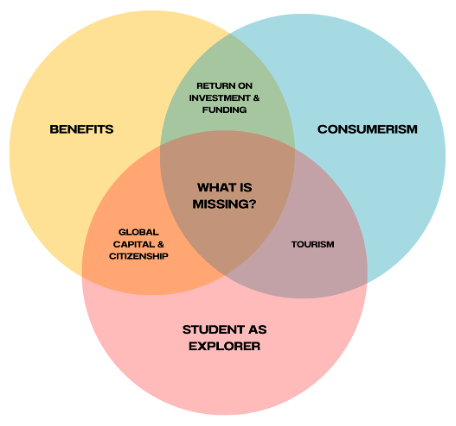
This study’s initial analysis identified three primary discourses surrounding community college study abroad: Benefits, Consumerism, and Students as Explorers. We also found three areas where these discourses overlapped: Return on Investment and Funding, Tourism, and Global Capital and Citizenship. Our analysis also draws attention to several notable absences from study abroad webpages.
Full Report
Be the first to know! Sign up for our newsletter to learn more about this project as we release reports and publications.
How to cite this page: Kline, L. (2025). Study abroad discourses. https://ccintled.pages.wm.edu/learn-about-our-research/study-abroad-discourses/